Section 184 - Dangerous & Rash Driving: Law, Punishment & Fines Explained
Dangerous or rash driving is treated as a serious public safety offence under Indian traffic law. Section 184 of the Motor Vehicles Act specifically addresses driving behaviour that poses a risk to human life, public property, or road safety.
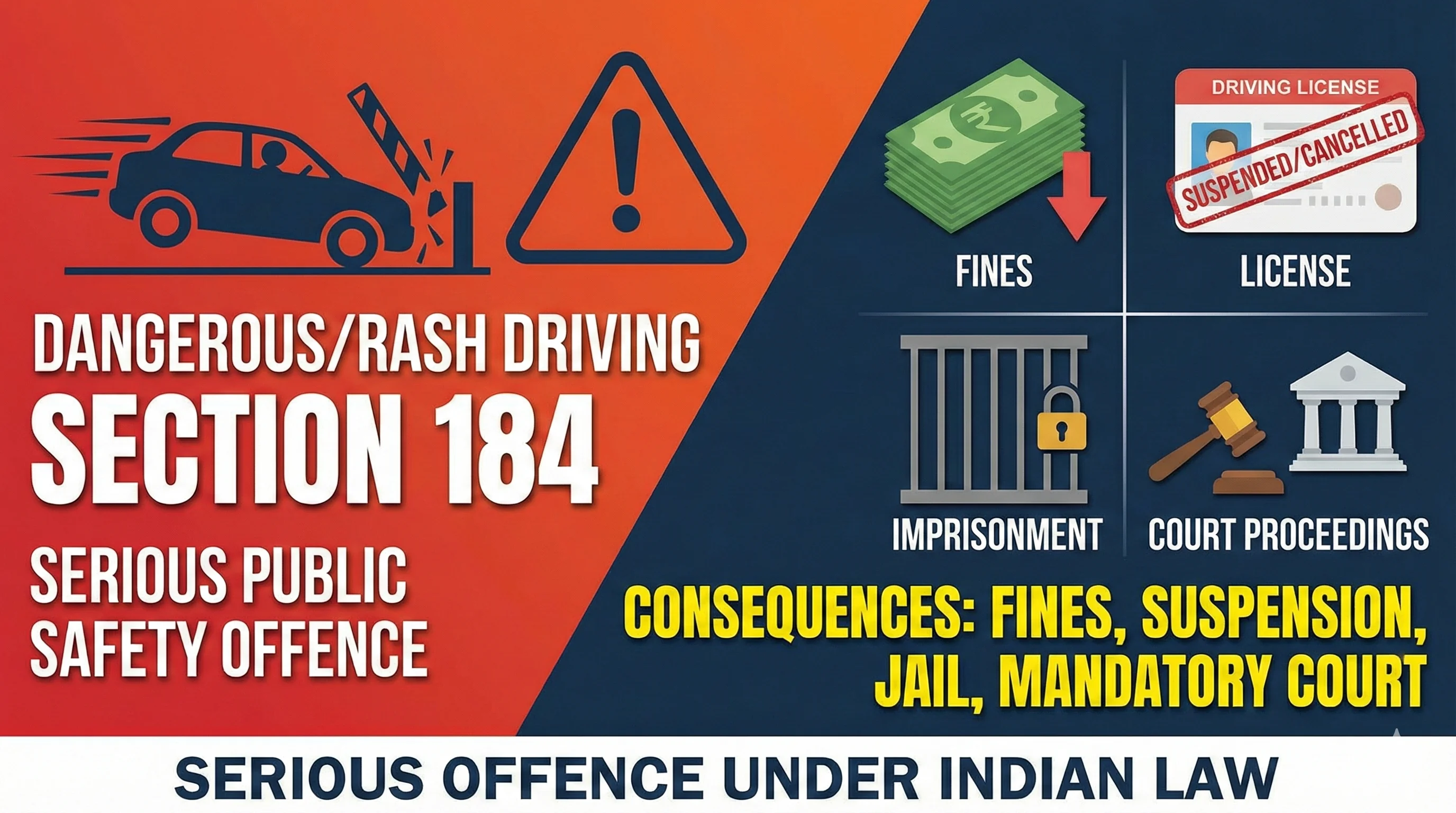
Unlike routine traffic violations, offences under Section 184 are considered grave in nature and may result in:
- Substantial monetary fines
- Suspension or cancellation of driving licence
- Imprisonment in serious or repeat cases
- Mandatory court proceedings
This page explains Section 184 in simple terms, including legal meaning, common real-world examples, punishments, and lawful ways to avoid penalties.
Last Updated: 2026
(As per the Motor Vehicles Act and prevailing enforcement practices in India)
What Is Section 184 of the Motor Vehicles Act?
Legal Definition (Simplified)
Section 184 states that any person who drives a motor vehicle dangerously or rashly, in a manner likely to cause injury, death, or damage to property, is punishable under law.
The focus of this section is driving behaviour, not just rule-breaking. Authorities assess whether the act:
- Showed disregard for road safety
- Created risk to pedestrians or other vehicles
- Violated basic standards of cautious driving
Examples of conduct treated as dangerous driving include:
- Driving at unsafe speeds
- Aggressive or abrupt lane changes
- Jumping traffic signals
- Using mobile phones while driving
- Driving under the influence (often combined with other sections)
- Ignoring traffic signs or road warnings
Section 184 draws its authority from the broader framework of the Motor Vehicles Act, strengthened through amendments aimed at reducing road fatalities.
Difference Between Rash Driving & Dangerous Driving
| Term | Meaning |
|---|---|
| Rash Driving | Driving without due care or control |
| Dangerous Driving | Driving that actively endangers life or property |
In practice, both forms are covered under Section 184 and punished based on severity, intent, and consequences.
Punishment Under Section 184 (Latest)
| Nature of Offence | Indicative Punishment |
|---|---|
| First offence | ₹1,000 - ₹5,000 fine |
| Repeat offence | ₹10,000 fine |
| Serious cases | Imprisonment up to 6 months |
| Repeat offence with injury | Jail + licence suspension |
Courts may also order community service where permitted. Jail is generally imposed when the act is severe, repeated, or results in harm.
Common Situations Where Section 184 Is Applied
Authorities commonly invoke Section 184 in situations such as:
- Using a mobile phone while driving
- Overspeeding in residential or school zones
- Racing or stunts on public roads
- Jumping red lights in a dangerous manner
- Aggressive driving in heavy traffic
- Multiple violations committed together
Many of these cases overlap with broader traffic offence enforcement, especially when captured through CCTV or speed cameras.
Can Driving Licence Be Suspended Under Section 184?
Yes.
Driving licence suspension is frequently ordered under Section 184, particularly when:
- The offence is repeated
- An accident or injury is involved
- Digital or CCTV evidence is available
Licence action may be taken by authorities directly or through court orders, depending on circumstances. The suspension process aligns with general driving licence laws in India.
Section 184 Along With Other MV Act Sections
Dangerous driving cases often involve combined charges, such as:
| Section | Reason |
|---|---|
| Section 181 | Driving without valid licence |
| Section 185 | Drink and drive |
| Section 196 | Driving without insurance |
| Section 199A | Minor driving |
For example, a drunk driving incident is usually booked under Section 185, along with Section 184 if driving behaviour was dangerous.
Is Mobile Phone Use Covered Under Section 184?
Yes.
Using a mobile phone while driving is treated as dangerous driving, not a minor violation.
Depending on circumstances, punishment may include:
- Monetary fine
- Licence disqualification
- Court appearance in repeat or serious cases
Courts consider mobile phone use a major distraction that significantly increases accident risk.
What Happens If an Accident Occurs Under Section 184?
If dangerous driving results in:
- Injury → Court proceedings and compensation liability
- Death → Additional criminal charges may apply
- Property damage → Insurance disputes and recovery
Insurance companies may reduce or reject claims if dangerous driving under Section 184 is established, especially when policy conditions are violated.
How Is Section 184 Enforced in India?
Enforcement typically involves:
- CCTV-based e-Challan systems
- On-road traffic police checks
- Dashcam or third-party evidence
- Witness complaints
- Virtual Traffic Court hearings
Most cases today are processed digitally, with summons issued through online portals.
How to Avoid Section 184 Penalty (Legal Safety Guide)
Drivers can reduce risk by:
- Driving within prescribed speed limits
- Avoiding mobile phone use while driving
- Maintaining lane discipline
- Obeying traffic signals and signs
- Never driving under the influence of alcohol or drugs
Following safe driving practices is both a legal requirement and a personal responsibility.
Relationship With Other Law Pages
This page is legally connected with:
Frequently Asked Questions
1.Is jail mandatory under Section 184?
No. Jail depends on severity, repetition, and consequences.
2.Is mobile phone use considered dangerous driving?
Yes. It is legally treated as dangerous driving.
3.Does Section 184 apply to two-wheelers?
Yes. It applies to all motor vehicles.
4.Is court appearance compulsory?
Only in serious or repeat cases.
Legal Disclaimer
This content is for informational purposes only. Legal interpretation, penalties, and enforcement may vary by state and individual case facts. Always verify with official transport authorities or court orders.