Motor Vehicles Act, 2019 - Complete & Simplified Guide for Indian Drivers
The Motor Vehicles Act, 2019 is the legal foundation that governs how vehicles are driven, licensed, insured, and penalised in India.
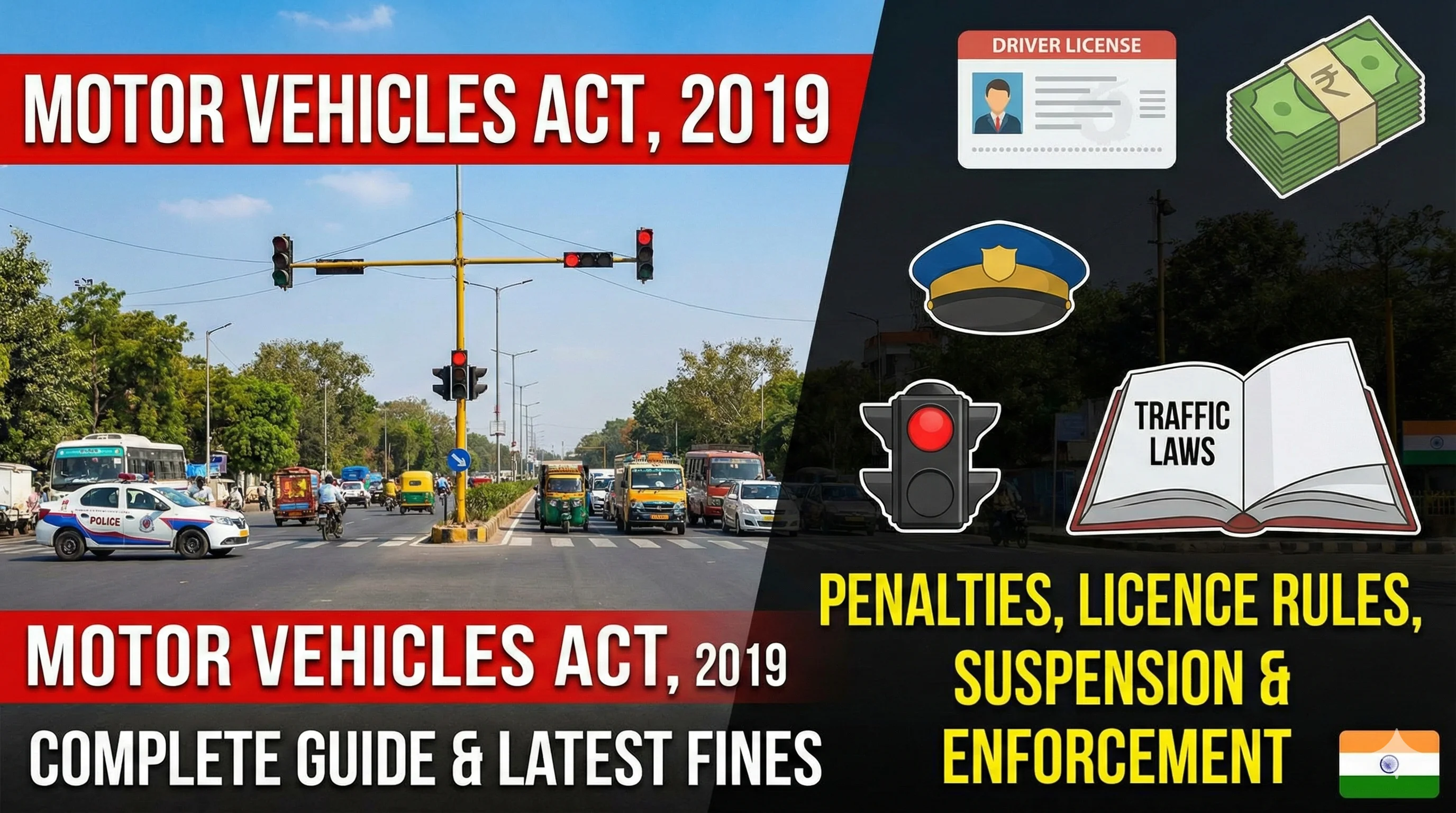
Every rule you encounter on Indian roads — from wearing a helmet, carrying a driving licence, paying a challan, or appearing in virtual court — originates from this Act.
The 2019 amendment was introduced because:
- Road accidents had reached crisis levels
- Penalties under older laws were ineffective
- Technology (CCTV, e-Challan, digital DLs) had no legal backing
- Repeat offenders escaped serious consequences
This law is not optional — it applies to every road user, whether you drive daily or occasionally.
Who Must Follow the Motor Vehicles Act?
The Act applies to:
- Two-wheeler riders
- Car drivers
- Commercial vehicle drivers
- Learner licence holders
- Vehicle owners (even if they are not driving)
- Parents/guardians of minor drivers
If you own, drive, allow, or permit a vehicle on a public road, this law applies to you.
Core Objectives of the Motor Vehicles Act, 2019
The Act is designed to achieve four legal objectives:
| Objective | Purpose |
|---|---|
| Road safety | Reduce accidents and fatalities |
| Driver accountability | Punish violations strictly |
| Licence discipline | Ensure only eligible people drive |
| Uniform enforcement | Same law across all states |
This is why penalties are high by design, not accidental.
Rights of Drivers Under the Motor Vehicles Act
Contrary to popular belief, the Act does not only punish drivers — it also protects them.
You have the legal right to:
- Use a digital driving licence instead of a physical card
- Receive a formal challan notice, not arbitrary fines
- Pay penalties through online or court-verified systems
- Contest incorrect challans in court
Digital rights are explained in: DigiLocker Driving Licence Guide.
Legal Duties of Drivers (What the Law Expects From You)
Under the Act, every driver is legally required to:
- Hold a valid driving licence for the vehicle category
- Follow speed limits and traffic signs
- Avoid driving under alcohol or drug influence
- Ensure the vehicle is insured and road-worthy
- Obey traffic police instructions
Failure to meet any one of these duties constitutes an offence.
Driving Licence Rules Explained (Conceptual)
A driving licence under the Act is not permission — it is legal certification of competence.
The law clearly states:
- No person may drive without a valid licence
- Licence categories are vehicle-specific
- Learner licences have restrictions
- Transport driving requires additional authorisation
Driving licence law explained in detail here: Driving Licence Laws in India.
Traffic Offences Explained (How Violations Are Classified)
The Act categorises offences into:
- Minor offences (documentation lapses)
- Major offences (dangerous behaviour)
- Criminal offences (risk to life)
- Strict liability offences (no excuse allowed)
Examples:
- No helmet → safety violation
- No insurance → financial liability offence
- Drink & drive → criminal offence
National overview: Traffic Offences in India.
Why Penalties Are So High (Legal Logic)
The Act follows a deterrence model:
"If violation is cheaper than compliance, people will violate."
High penalties exist to:
- Force behavioural change
- Prevent repeat offences
- Hold vehicle owners accountable
- Reduce fatalities, not collect revenue
Juvenile Driving: Zero-Tolerance Framework
The 2019 Act fundamentally changed juvenile driving laws.
If a minor drives:
- Parents/guardians are fined heavily
- Vehicle registration can be cancelled
- Jail terms may apply
- Minor becomes ineligible for licence later
This is one of the strictest provisions in Indian traffic law.
Digital Enforcement & Virtual Courts
The Act legally enables:
- CCTV-based challans
- Centralised vehicle-DL databases
- Online payment systems
- Virtual court adjudication
This removes discretion and corruption from enforcement.
Systems explained here: Parivahan Portal Explained.
How States Implement the Motor Vehicles Act
The Act is central, but enforcement is state-level.
States can:
- Increase surveillance
- Add local enforcement rules
- Prioritise certain violations
This is why penalties feel stricter in some states.
State examples:
Licence Suspension & Cancellation Explained
Licences are suspended when:
- Serious offences are committed
- Violations are repeated
- Court orders are issued
Licences are cancelled when:
- Fraud is detected
- Juvenile offences occur
- Law is deliberately violated
Problem guides: Driving Licence Cancelled.
How to Stay Fully Compliant (Practical Advice)
To remain legally safe:
- Renew licences on time
- Drive only authorised vehicles
- Avoid repeat violations
- Check challan status regularly
- Never allow minors to drive
Frequently Asked Questions
1.What is the Motor Vehicles Act, 2019?
The Motor Vehicles Act, 2019 is India's primary traffic and road transport law governing driving licences, vehicle registration, traffic offences, penalties, accident compensation, and enforcement powers.
2.Is the Motor Vehicles Act applicable in all Indian states?
Yes, the Motor Vehicles Act is a central law applicable across all Indian states and union territories, with enforcement carried out by state traffic authorities.
3.What changed in the Motor Vehicles Act after 2019?
The 2019 amendment introduced higher penalties, digital enforcement, owner and guardian liability, stricter punishment for repeat offences, and improved accident compensation mechanisms.
4.Can a driving licence be suspended under the Motor Vehicles Act?
Yes, driving licences can be suspended or cancelled for serious or repeat offences such as dangerous driving, drink and drive, and driving without a valid licence.
Legal Disclaimer
This page is for informational purposes only. The Motor Vehicles Act, 2019 is a complex legal document, and interpretations may vary. Always verify legal requirements with official government sources or consult legal professionals for specific situations.