Common Driving Licence Test Mistakes (India)
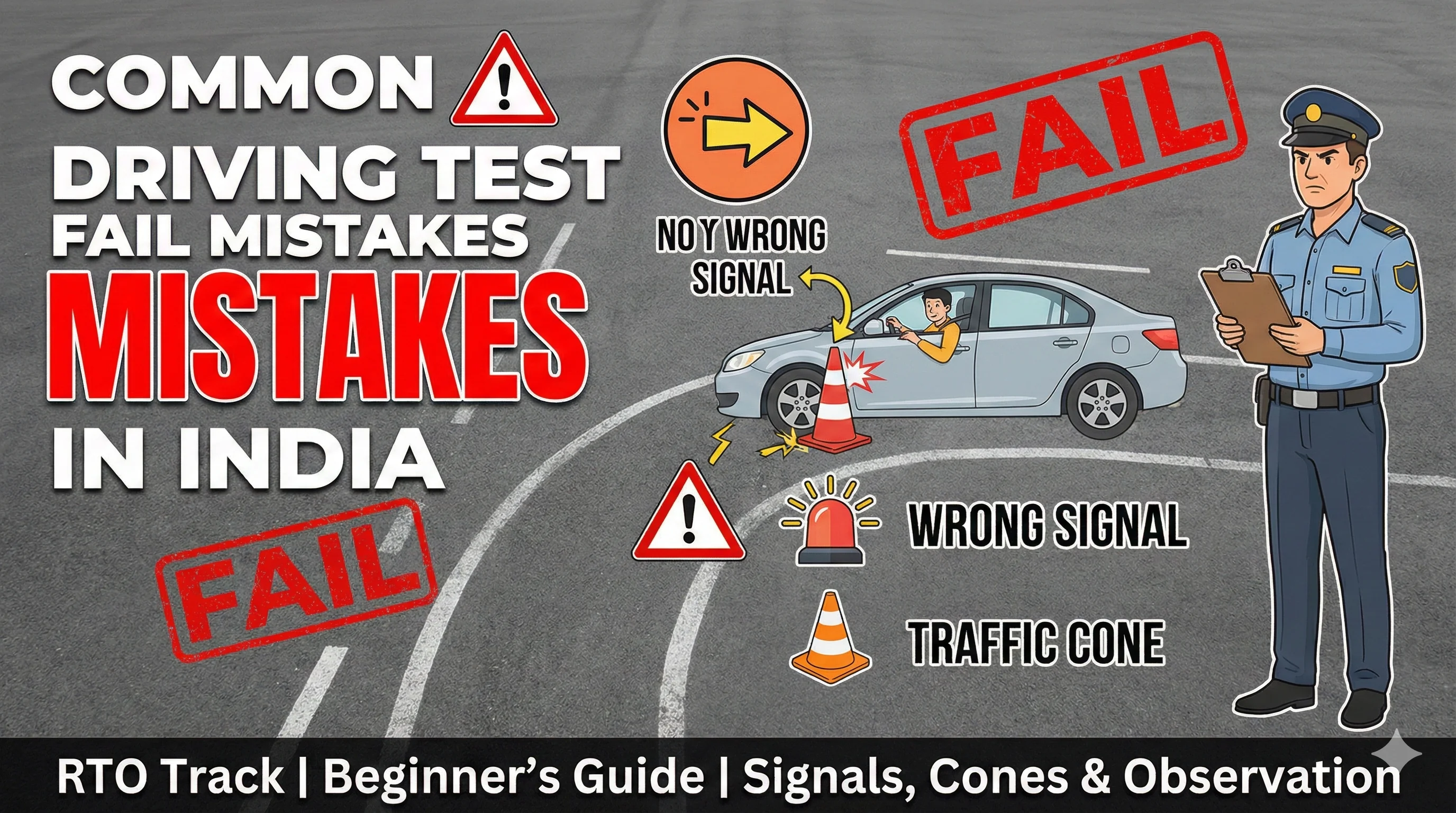
Common driving licence test mistakes in India include not using indicators, touching feet on the ground, crossing lane markings, engine stalling, panic during the test, and misunderstanding RTO evaluation rules. These errors lead to failure even if the applicant knows driving.
Why Understanding Driving Licence Test Mistakes Is Important
Most applicants fail the driving licence test not because they can't drive, but because they repeat small, avoidable mistakes.
The RTO test is:
- Rule-based
- Observation-based
- Zero-tolerance for certain errors
Understanding mistakes before appearing in the test:
- Reduces fear
- Improves control
- Increases first-attempt success
What the Driving Licence Test Actually Evaluates
The driving licence test evaluates:
- Rule compliance
- Vehicle control
- Calm behaviour
- Situational awareness
It does not evaluate:
- Speed
- Confidence level
- Experience on highways
All tests are conducted under standardized guidelines implemented through systems managed by Parivahan Sewa.
Common Driving Licence Test Mistakes (Explained Clearly)
1️⃣ Not Using Indicators at the Right Time
This is the most repeated mistake.
Candidates often:
- Forget indicators during turns
- Signal too late
- Leave indicators on after turn
In test evaluation:
- Indicator misuse = rule violation
- Rule violation = failure
Even a single missed indicator can end the test.
2️⃣ Touching Foot on Ground (Two-Wheeler Test)
For two-wheeler applicants:
- Balance is mandatory
- Foot touching ground = loss of control
Common moments of failure:
- Slow turns
- Nervous braking
- Uneven clutch-throttle balance
The test checks stability, not speed.
3️⃣ Crossing Lane Markings or Touching Cones
Most RTO tracks include:
- H-track
- 8-track
- Cone-based lanes
Mistakes include:
- Tyres crossing white lines
- Brushing cones
- Over-steering
These indicate poor lane discipline.
4️⃣ Engine Stalling (Car Test)
Car applicants often fail due to:
- Improper clutch control
- Sudden braking
- Panic acceleration
Engine stalling shows:
- Lack of vehicle handling
- Nervousness under pressure
Slow and steady movement is preferred.
5️⃣ Ignoring Stop Lines and Pause Rules
Some test tracks require:
- Complete halt at stop line
- Pause before restart
Common mistakes:
- Rolling stop
- Half-clutch movement
- Immediate acceleration
A proper stop means full halt + short pause.
6️⃣ Starting Before Examiner Instruction
Candidates sometimes:
- Start without signal
- Assume permission
- Rush into movement
The examiner's instruction is part of the evaluation.
Ignoring it leads to immediate failure.
7️⃣ Panic and Nervous Driving
Nervousness causes:
- Over-steering
- Sudden braking
- Missed signals
Ironically, experienced drivers panic more because they:
- Overthink
- Try to be perfect
- Rush corrections
Calm driving is scored higher than confident driving.
8️⃣ Poor Familiarity With Test Track
Many applicants:
- See the track for the first time on test day
- Don't know turning points
- Misjudge space
This results in:
- Cone touches
- Lane crossing
- Balance loss
Track familiarity matters.
9️⃣ Vehicle-Related Oversights
Failure can occur if:
- Indicators don't work
- Brake lights fail
- Mirrors are missing
The vehicle must be:
- Fully functional
- Test-ready
- Rule-compliant
Mechanical issues are treated as applicant responsibility.
🔟 Misunderstanding Evaluation Criteria
Applicants often don't know:
- Which mistakes are instant-fail
- Which are tolerated once
- What examiner focuses on
They rely on:
- Agent advice
- Rumours
- Guesswork
This confusion causes avoidable failure.
Are These Mistakes Same for All States?
Yes.
While:
- Track design may vary
The evaluation rules remain uniform across India.
Mistakes that cause failure are the same everywhere.
Difference Between Mistakes and Skill Issues
Mistakes are:
- Rule violations
- Avoidable errors
- Behavioural lapses
Skill issues improve with practice.
Mistakes improve with awareness.
What Happens If You Repeat These Mistakes?
Repeating mistakes leads to:
- Test failure
- Re-booking delay
- Longer licence process
Understanding mistakes early saves time and effort.
To understand more about dl exam overview, read our comprehensive guide. For information about practice test reference, you can learn more here.
Final Summary (Exam-Oriented)
- Driving licence test failures happen due to mistakes, not lack of driving
- Indicator misuse is the top error
- Lane discipline and balance are critical
- Panic causes most failures
- Understanding mistakes improves first-attempt success
- Avoiding mistakes is as important as knowing how to drive
Awareness of common mistakes is the first step to passing the test.
To understand more about licence process reference, visit our services page. You can check your driving licence status online for application status.
Frequently Asked Questions
1.What are the most common driving licence test mistakes?
Indicator misuse, lane crossing, balance loss, and panic. These mistakes cause failure even when applicants know how to drive.
2.Can small mistakes cause failure?
Yes, some mistakes result in instant failure. Rule violations like missing indicators or touching cones lead to immediate disqualification.
3.Do experienced drivers also make these mistakes?
Yes, overconfidence and nervousness cause errors. Experienced drivers often fail due to underestimating test rules.
4.Is touching cones allowed in the test?
No, touching cones leads to failure. Even brushing against cones shows lack of lane discipline and control.
5.Are these mistakes same for car and bike tests?
Core mistakes are same, focus areas differ slightly. Balance is critical for bikes, clutch control matters more for cars.
6.Can mistakes be avoided with awareness?
Yes, understanding mistakes greatly reduces failure chances. Awareness of common errors improves first-attempt success rate.