Driving Licence Test Rules Explained (India)
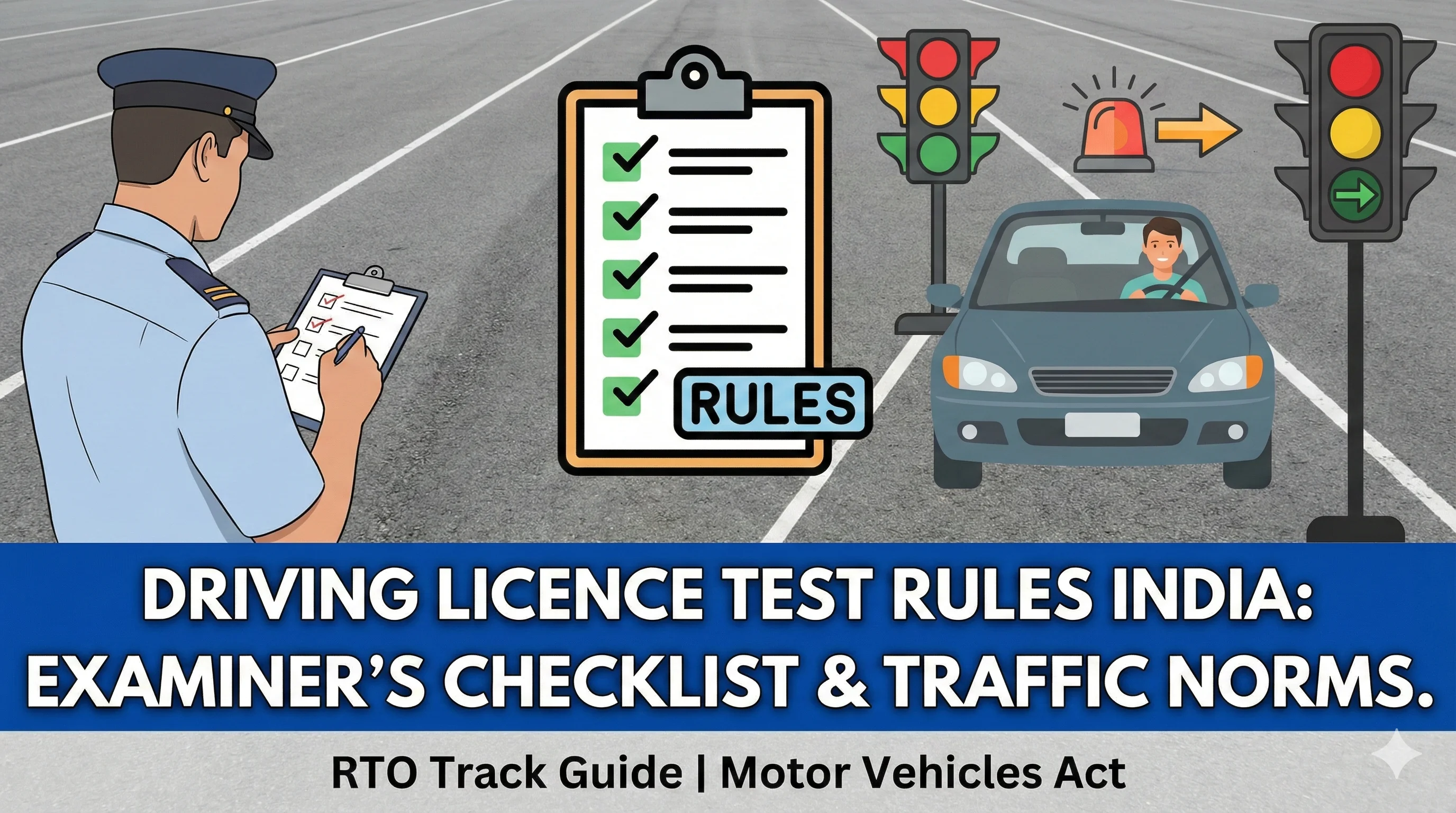
Driving licence test rules in India are strictly rule-based and focus on indicator usage, lane discipline, vehicle control, stopping behaviour, and obedience to examiner instructions. Even a single rule violation-such as missing an indicator or crossing a lane-can lead to immediate failure.
Why Understanding Driving Licence Test Rules Is Critical
Most candidates fail the driving licence test not due to lack of driving skill, but due to lack of rule clarity.
Many applicants:
- Assume "normal driving" is enough
- Ignore small rule details
- Depend on agent advice
The driving licence test does not reward experience.
It rewards discipline, predictability, and rule awareness.
Knowing the rules before entering the test track drastically improves success rate.
Who Decides Driving Licence Test Rules in India?
Driving licence test rules are framed under the Motor Vehicles Act and implemented uniformly across India through systems managed by Parivahan Sewa.
Important points:
- Rules are national, not state-specific
- Track design may vary
- Evaluation logic remains the same
This means a mistake that causes failure in one state will cause failure in every state.
What the Driving Licence Test Is Designed to Measure
The test is not a driving competition.
It is a compliance test.
Examiners evaluate:
- Whether you follow rules automatically
- Whether you remain calm under observation
- Whether your actions are predictable and safe
They do not evaluate:
- Speed
- Confidence
- Aggressive control
Understanding this mindset is the foundation of passing.
To understand more about test overview, read our comprehensive guide.
Core Driving Licence Test Rules You Must Follow
1️⃣ Indicator Usage Rules (Most Important)
Indicator usage is the highest-weight rule in the test.
You must use indicators:
- Before every turn
- During lane changes
- When entering or exiting the test track
Key rule:
Indicator usage is mandatory even if there is no traffic.
From the examiner's perspective:
- Indicators show habit
- Habit shows training
- Training shows safety
Missing an indicator once can result in instant failure.
2️⃣ Lane Discipline Rules
Lane discipline means:
- Staying fully inside marked boundaries
- Not crossing white lines
- Not touching cones
Crossing boundaries indicates:
- Poor judgement
- Lack of spatial awareness
- Unsafe driving tendency
Lane violations are usually treated as non-recoverable mistakes.
3️⃣ Speed Control Rules
There is no minimum speed requirement.
Rules expect:
- Slow movement
- Smooth acceleration
- No sudden braking
Driving too fast:
- Increases error probability
- Signals impatience
Driving slowly:
- Shows control
- Reduces panic
- Allows correction
Slow driving is not penalised.
4️⃣ Stop Line and Halt Rules
If a stop line or halt point exists:
- Vehicle must stop completely
- Wheels must be stationary
- Pause must be visible
A rolling stop is considered:
- Ignoring traffic law
- Unsafe behaviour
The pause proves intentional obedience.
5️⃣ Examiner Instruction Rules
Examiner instructions are part of the test.
Rules require you to:
- Start only after instruction
- Stop immediately when told
- Follow signals without argument
Starting without permission shows:
- Lack of discipline
- Poor listening skills
This often results in immediate failure.
6️⃣ Balance Rules (Two-Wheeler Test)
For two-wheelers:
- Foot must not touch ground
- Balance must be maintained throughout
Foot touching ground indicates:
- Loss of control
- Unsafe handling
Even a momentary foot touch is treated as failure.
7️⃣ Clutch and Engine Control Rules (Car Test)
For cars:
- Excessive stalling is discouraged
- Jerky movement is penalised
Stalling once may be tolerated in some centres, but:
- Repeated stalling = failure
Smooth clutch control reflects preparedness.
8️⃣ Vehicle Condition Rules
Your vehicle must be:
- Mechanically sound
- Fully functional
Mandatory checks include:
- Working indicators
- Brake lights
- Mirrors
Vehicle defects are treated as driver responsibility, not RTO fault.
What Are Instant-Fail Mistakes?
Instant-fail mistakes usually include:
- Missing indicators
- Crossing lane boundaries
- Touching cones
- Foot touching ground (two-wheeler)
- Ignoring examiner instruction
These mistakes end the test immediately.
To understand more about instant-fail mistakes, read our comprehensive guide.
Are Driving Licence Test Rules Same for Everyone?
Yes.
Rules apply equally to:
- First-time drivers
- Experienced drivers
- Two-wheeler and car applicants
Only evaluation focus changes slightly based on vehicle type.
Why Experienced Drivers Fail Due to Rules
Experienced drivers often:
- Drive by habit
- Ignore formal rules
- Rush the test
The test rewards:
- Conscious driving
- Predictable actions
- Visible compliance
Habit-based driving often violates test rules.
How Rule Awareness Improves First-Attempt Success
Candidates who know rules:
- Drive slower
- Use indicators automatically
- Anticipate examiner expectations
Rule awareness removes guesswork and panic.
To understand more about test track explained, read our comprehensive guide.
What Happens If You Break a Rule?
If you break a rule:
- Test may end immediately
- Rebooking becomes mandatory
- Waiting period applies
Rules are enforced strictly to ensure road safety.
Final Summary (Exam-Oriented)
- Driving licence test is rule-centric
- Indicator usage is mandatory
- Lane discipline is non-negotiable
- Speed control matters more than speed
- Examiner instructions must be followed
- Rule awareness increases success rate
- Passing the test is about obedience, not bravado
Understanding and following official rules is the foundation of test success.
To understand more about licence process reference, visit our services page. You can check your driving licence status online for application status.
Frequently Asked Questions
1.Are driving licence test rules strict?
Yes, rule violations can lead to immediate failure. The test follows strict rule-based evaluation, and even a single violation like missing an indicator or crossing a lane boundary can result in test termination.
2.Is indicator mandatory on empty test tracks?
Yes, indicators are compulsory regardless of traffic. Indicator usage is mandatory even on empty test tracks as it demonstrates habitual rule compliance and safety awareness.
3.Can slow driving cause failure?
No, slow and controlled driving is preferred. There is no minimum speed requirement, and examiners reward control and rule compliance over speed.
4.Are rules same in all states?
Yes, evaluation rules are uniform across India. Rules are framed under the Motor Vehicles Act and implemented uniformly through Parivahan Sewa, though track design may vary by state.
5.Can vehicle issues cause failure?
Yes, non-functional indicators or lights can disqualify the test. Vehicle defects are treated as driver responsibility, and the vehicle must be fully functional and road-worthy.
6.What happens if I break a rule during the test?
Breaking a rule can result in immediate test termination, mandatory rebooking, and waiting period. Instant-fail mistakes like missing indicators or crossing lane boundaries end the test immediately.