Driving Licence Test Track Explained (India)
The driving licence test track in India is a controlled driving layout designed to evaluate lane discipline, balance, steering control, indicator usage, and rule compliance. Common track types include H-track, 8-track, and cone-based lanes. Touching boundaries, cones, or losing balance leads to failure.
Why Driving Licence Test Track Causes Maximum Failures
Many applicants fail the driving licence test not because of poor driving, but because they don't understand the logic behind the test track.
The track is designed to:
- Remove real-world traffic distractions
- Isolate specific driving skills
- Expose lack of discipline
The moment you enter the track, the examiner can clearly see:
- Steering control
- Speed management
- Rule awareness
The track does not forgive guesswork.
What Is a Driving Licence Test Track?
A driving licence test track is:
- A fixed driving layout at the RTO
- Marked with lanes, cones, and stop lines
- Used to evaluate practical driving skills
It tests control, not confidence.
All test tracks are evaluated under standardized rules implemented through systems managed by Parivahan Sewa.
Why Test Track Driving Is Different From Road Driving
On real roads:
- You adjust based on traffic
- Minor rule lapses go unnoticed
On test tracks:
- Every movement is observed
- There is zero tolerance for certain errors
The track exaggerates mistakes so examiners can objectively evaluate skill and discipline.
Common Types of Driving Licence Test Tracks in India
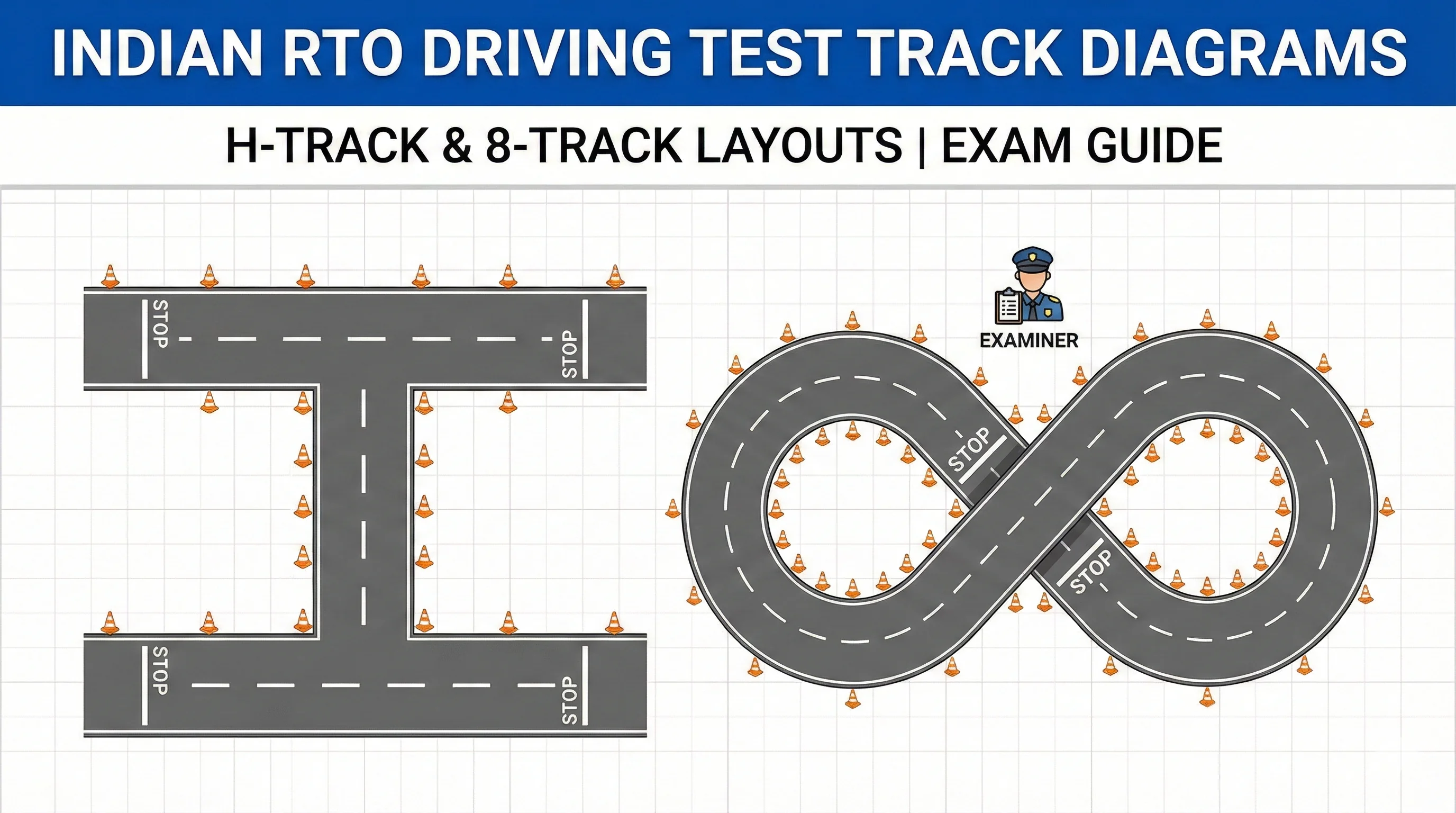
1️⃣ H-Track (Most Common)
The H-track is widely used for car driving tests.
Structure:
- Two parallel lanes connected by a middle cross lane
- White boundary lines on all sides
What the H-Track Tests:
- Steering accuracy
- Lane judgement
- Clutch control at low speed
Why Candidates Fail on H-Track:
- Over-steering at turns
- Poor clutch-brake coordination
- Looking down instead of ahead
Crossing any boundary line results in immediate failure.
2️⃣ 8-Track (Common for Two-Wheelers)
The 8-track tests balance and coordination.
Structure:
- Figure-8 shaped lane
- Narrow turning radius
What It Evaluates:
- Balance at slow speed
- Throttle control
- Steering smoothness
Why Candidates Fail:
- Touching foot on ground
- Losing balance mid-turn
- Sudden braking
Even a single foot touch leads to failure.
3️⃣ Cone-Based Track
Some RTOs use cone tracks instead of painted lines.
Purpose:
- Test spatial judgement
- Evaluate steering precision
Failure Reasons:
- Touching cones
- Driving outside path
Cone contact clearly indicates poor control.
How Examiners Evaluate You on the Track
Examiners do not subjectively judge you.
They check specific criteria:
- Did you stay within boundaries?
- Did you use indicators correctly?
- Was speed controlled?
- Did you follow instructions?
Each mistake has a defined outcome.
To understand more about test overview, read our comprehensive guide.
Importance of Indicator Usage on the Track
Many candidates think:
"There is no traffic, indicators are optional."
This assumption causes instant failure.
Indicators on the track prove:
- Habitual rule compliance
- Awareness of driving protocol
Missing an indicator, even once, is often treated as test failure.
Speed Control on the Test Track
The correct speed on a test track is:
- Slow
- Predictable
- Controlled
High speed causes:
- Lane crossing
- Balance loss
- Panic corrections
Examiners prefer drivers who:
- Maintain constant speed
- Avoid sudden acceleration
Why Looking Ahead Matters More Than Looking Down
A common beginner mistake is:
- Looking at tyres
- Watching lane lines closely
This causes:
- Late steering corrections
- Zig-zag movement
Experienced test-passers:
- Look ahead
- Trust steering input
- Make smooth adjustments
Your eyes control your vehicle more than your hands.
Stop Lines and Pause Evaluation on Track
Some tracks include:
- Mandatory stop points
Correct stopping means:
- Full halt
- Wheels stationary
- Short pause
Rolling stops indicate:
- Rule ignorance
- Unsafe behaviour
Two-Wheeler Balance Psychology on Track
Balance issues occur due to:
- Fear of falling
- Over-braking
- Inconsistent throttle
Balance improves when:
- Throttle remains steady
- Eyes focus ahead
- Confidence is calm, not aggressive
The track punishes panic more than lack of skill.
Car Test Track: Clutch Control Is the Deciding Factor
For cars, most failures occur due to:
- Engine stalling
- Jerky movement
Examiners interpret stalling as:
- Nervousness
- Poor vehicle control
Smooth clutch release matters more than speed.
Can Track Design Differ Between States?
Yes, design may vary:
- Width
- Shape
- Cone vs line
But evaluation rules remain the same nationwide.
Mistakes that cause failure in one state cause failure everywhere.
Why Practicing on Open Roads Is Not Enough
Open-road driving does not prepare you for:
- Tight turns
- Low-speed balance
- Artificial constraints
Track practice improves:
- Precision
- Rule discipline
- Test confidence
To understand more about common mistakes, read our comprehensive guide. For information about pass in first attempt, you can learn more here.
What Happens If You Fail on the Track?
Failure results in:
- Test termination
- Rebooking requirement
- Waiting period
Most failures are avoidable with track awareness.
Final Summary (Exam-Oriented)
- Driving licence test track isolates driving discipline
- H-track tests steering & clutch control
- 8-track tests balance & throttle control
- Indicators are mandatory
- Slow, calm driving is ideal
- Understanding the test track converts fear into confidence
Track awareness and rule compliance are the foundations of test success.
To understand more about licence process reference, visit our services page. You can check your driving licence status online for application status.
Frequently Asked Questions
1.What is H-track in driving licence test?
It is a lane-based test track used to evaluate steering, clutch control, and lane discipline. The H-track consists of two parallel lanes connected by a middle cross lane, testing precision and rule compliance.
2.Is touching cones allowed?
No, touching cones leads to failure. Cone contact clearly indicates poor control and spatial judgement, resulting in immediate test disqualification.
3.Are test tracks same everywhere?
Layout may differ, but evaluation rules are the same. Track design varies by RTO, but mistakes that cause failure remain consistent nationwide.
4.Why do candidates fail on track despite knowing driving?
Due to lack of track awareness and rule discipline. Test track driving requires precision and rule compliance, which differs from open-road driving.
5.Is slow driving better on track?
Yes, slow and controlled driving is preferred. Examiners reward control and rule compliance over speed. Slow speed reduces errors and improves precision.
6.What does 8-track test evaluate?
The 8-track tests balance, throttle control, and steering smoothness at slow speed. It is commonly used for two-wheeler tests and evaluates coordination and control.