Traffic Offences in India - Complete List of Violations, Fines & Legal Consequences
Traffic offences in India are regulated under the Motor Vehicles Act, 1988, along with the Motor Vehicles (Amendment) Act, 2019, which strengthened penalties and introduced digital enforcement systems.
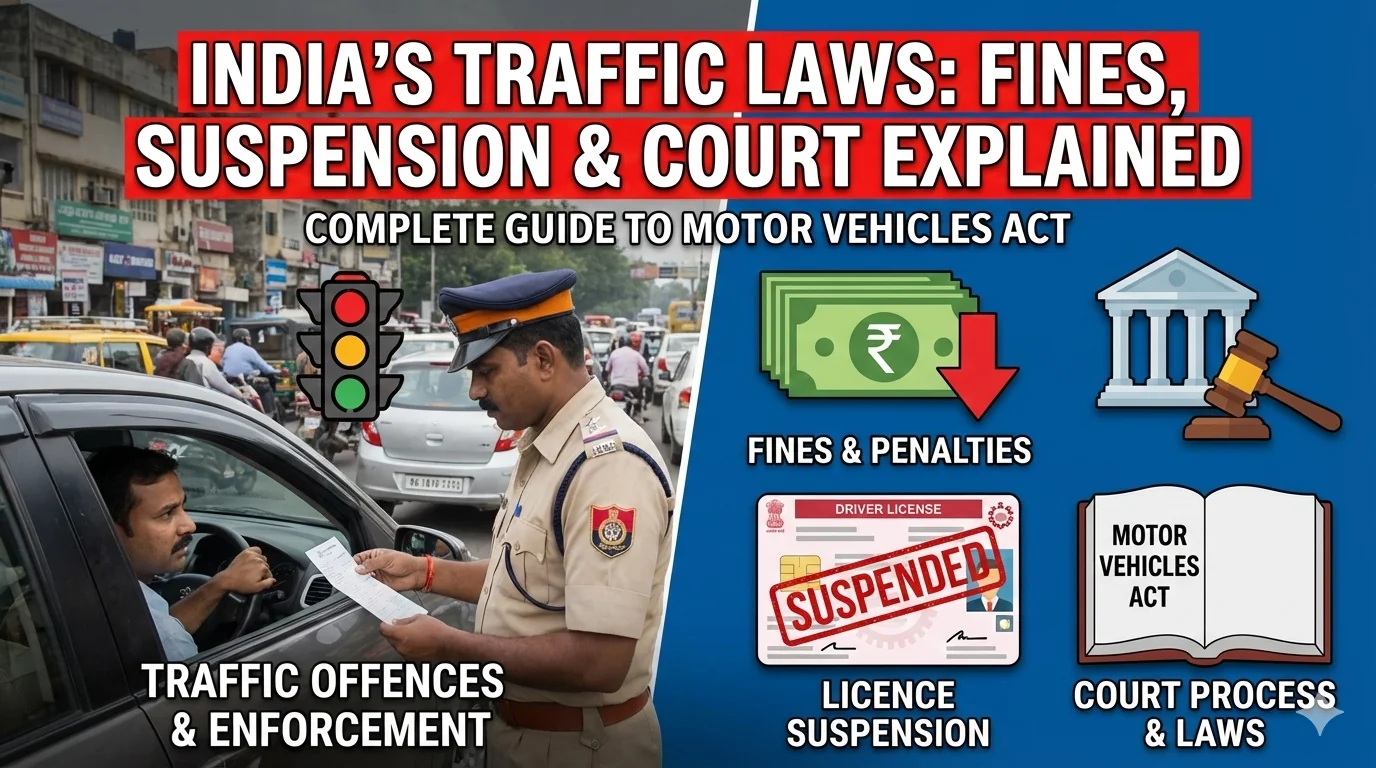
A traffic offence refers to any violation of road safety rules, driving licence conditions, or vehicle regulations that can endanger public safety or disrupt lawful traffic movement.
Today, traffic law enforcement in India is carried out through a combination of physical checks and digital systems, ensuring uniform application across states and Union Territories.
Traffic rules are enforced by:
- State Traffic Police departments
- Regional Transport Offices (RTOs)
- National e-Challan systems
- Virtual Traffic Courts
This guide explains:
- What legally qualifies as a traffic offence
- Categories of violations under Indian law
- Applicable penalties and punishments
- When court proceedings are initiated
- How offences affect your driving licence
- Rights and responsibilities of vehicle owners and drivers
Last Updated: 2026
(Based on the Motor Vehicles Act and current national enforcement practices)
Quick Overview: Traffic Offences in India
| Topic | Summary |
|---|---|
| Governing Law | Motor Vehicles Act (Amended 2019) |
| Applicability | All States & Union Territories |
| Enforcement Authorities | Traffic Police, RTO, Virtual Courts |
| Penalties | Fine, licence suspension, imprisonment |
| Detection Methods | CCTV, speed cameras, ANPR |
| Repeat Violations | Higher fines + court action |
What Is a Traffic Offence in India?
A traffic offence is any action or omission that violates road traffic rules prescribed under Indian motor vehicle laws.
These offences broadly include:
- Unsafe or negligent driving behaviour
- Driving without valid licence or vehicle documents
- Violating traffic signals or speed limits
- Endangering pedestrians or other road users
- Disobeying lawful instructions of traffic authorities
Driving a motor vehicle without a valid licence is a punishable offence. If you are not yet licensed, you must apply through the official process explained in the Driving Licence Online Application guide.
Categories of Traffic Offences in India
1️⃣ Licence-Related Offences
These offences relate to violations of driving licence conditions, including:
- Driving without holding a valid driving licence
- Driving with an expired or suspended licence
- Driving a vehicle category not endorsed on the licence
- Continuing to drive despite court-ordered disqualification
Such violations are commonly dealt with under Sections 3 and 181 of the Motor Vehicles Act.
2️⃣ Dangerous & Rash Driving Offences
Dangerous driving offences pose serious risk to life and property and include:
- Over-speeding beyond permitted limits
- Rash or negligent driving
- Using mobile phones while driving
- Driving under the influence of alcohol or drugs
These offences are punishable under Sections 184 and 185, and may result in imprisonment, licence suspension, or both, depending on severity.
3️⃣ Vehicle & Document-Related Offences
Vehicle compliance offences include:
- Driving without valid motor insurance
- Absence of Pollution Under Control (PUC) certificate
- Using unsafe or mechanically unfit vehicles
- Displaying illegal or altered number plates
Driving without insurance is a serious offence under Section 196, often leading to vehicle seizure.
4️⃣ Public Safety & Social Responsibility Offences
These offences affect overall road safety:
- Not wearing helmet or seat belt
- Triple riding on two-wheelers
- Blocking ambulances or emergency vehicles
- Overloading passengers or commercial goods
While these may seem minor, repeat violations can result in higher penalties and licence action.
5️⃣ Juvenile Driving & Owner Liability Offences
Indian law places strict responsibility on vehicle owners:
- Allowing a minor to drive a motor vehicle
- Failure of guardian or owner to prevent misuse
- Possible cancellation of vehicle registration
Under Section 199A, juvenile driving cases can result in heavy fines, imprisonment, and RC cancellation.
Major Traffic Offences & Penalties in India
| Offence | Indicative Penalty | Legal Consequence |
|---|---|---|
| Driving without licence | ₹5,000 | Court or community service |
| Over-speeding | ₹1,000-₹4,000 | Licence impound |
| Dangerous driving | ₹5,000-₹10,000 | Jail possible |
| Drink & drive | ₹10,000-₹15,000 | Jail + suspension |
| No insurance | ₹2,000-₹4,000 | Vehicle seizure |
| Juvenile driving | ₹25,000 | Jail + RC cancellation |
Penalties may vary by state and circumstances.
How Traffic Offences Are Detected in India
Modern traffic enforcement relies heavily on digital systems such as:
- CCTV and speed surveillance cameras
- Automatic Number Plate Recognition (ANPR)
- On-road police verification devices
- Centralised vehicle and licence databases
Most challans today are camera-generated, reducing manual intervention. Drivers can verify violations using their driving licence status or vehicle number.
What Happens After a Traffic Offence?
Once a violation is detected:
An e-Challan is generated
Notification is sent via SMS or online portal
A payment window is provided
Unpaid challans escalate to Virtual Traffic Court
Serious offences may lead to licence suspension or summons
Learn more about the Virtual Traffic Court process to understand hearings and settlements.
Impact of Traffic Offences on Driving Licence
Repeated or serious violations can lead to:
- Accumulation of penalty points (state-specific)
- Temporary suspension of licence
- Permanent cancellation in extreme cases
- Complications during licence renewal
Drivers are advised to periodically check their driving licence renewal status, especially after multiple challans.
Rights of Drivers Under Indian Traffic Law
Every driver has the right to:
- View challan details and evidence
- Contest incorrect challans in court
- Use legally valid digital licences (DigiLocker / mParivahan)
- Receive proper notice before suspension or cancellation
How to Avoid Traffic Offences in India
- Carry valid physical or digital driving licence
- Drive only authorised vehicle categories
- Follow speed limits and traffic signals
- Renew documents before expiry
- Never allow minors to operate vehicles
Relationship With Other Legal Pages
This page is legally connected with:
Frequently Asked Questions
1.Are traffic offences the same across all states?
Yes, offences are defined centrally, but enforcement intensity may vary.
2.Can police suspend a licence without court approval?
Yes, for certain offences. Serious cases are referred to court.
3.Is jail mandatory for all traffic offences?
No. Imprisonment applies mainly to serious violations.
4.Are digital driving licences legally valid?
Yes, licences stored in DigiLocker and mParivahan are valid.
Legal Disclaimer
This content is for informational purposes only. Traffic laws, penalties, and enforcement practices are subject to amendments and state-level variations. Always verify details with official transport or traffic authorities.