How Parivahan Portal Works - Complete Guide to Driving Licence & Vehicle Services in India
Before Parivahan, India's transport system was fragmented. Each state maintained its own driving licence records, vehicle registrations, and enforcement data. This caused duplicate driving licences across states, fake or unverifiable licences, no central offence tracking, manual RTO dependency, and weak traffic law enforcement.
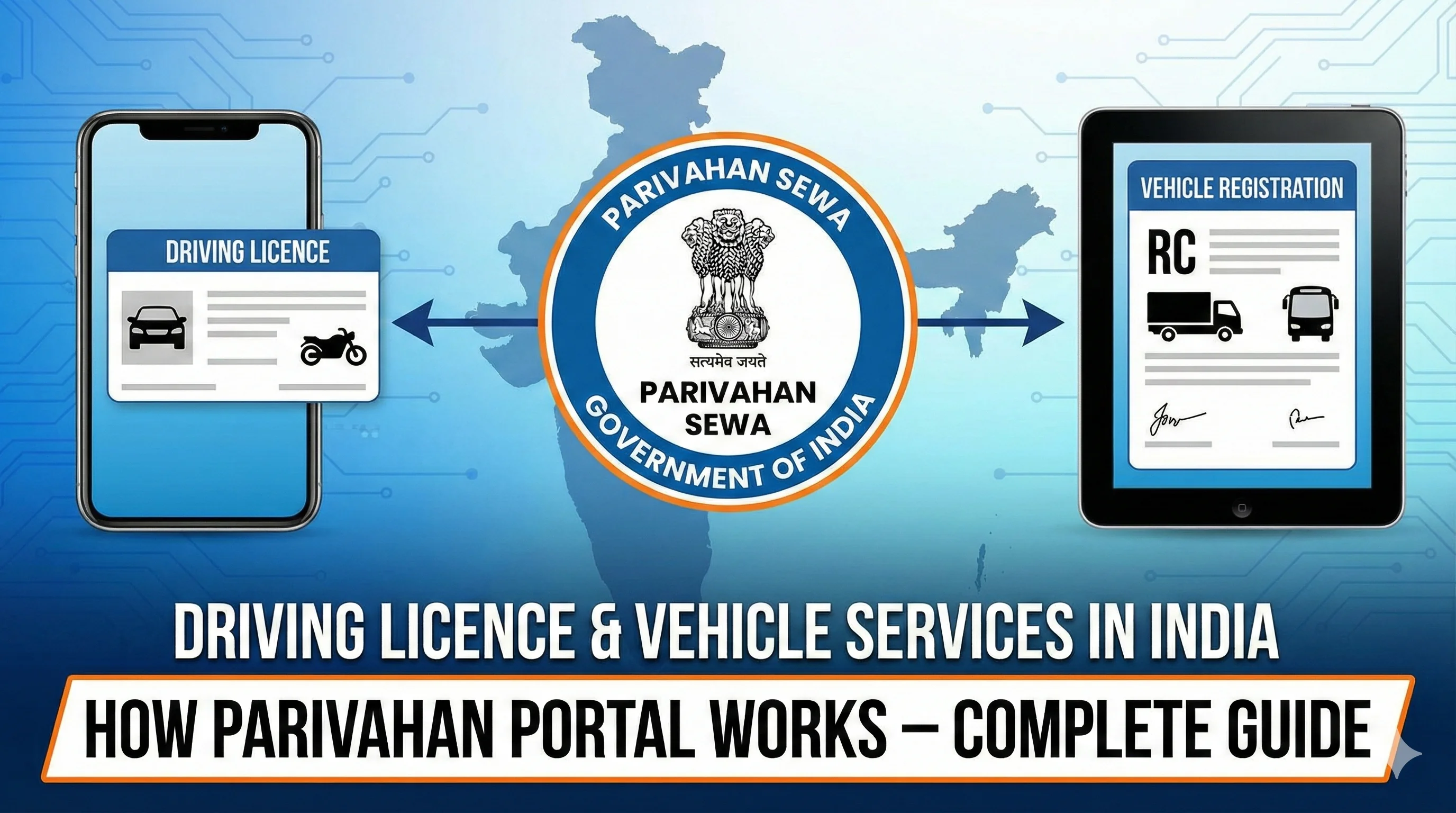
To fix this, the Government of India launched Parivahan Sewa, a nationwide digital transport backbone under the Ministry of Road Transport & Highways (MoRTH).
Today, every driving licence, vehicle registration, challan, and enforcement action in India is linked to Parivahan.
This page explains:
- What Parivahan really is (beyond "apply online")
- How it works internally
- How citizens, RTOs, and police use it
- Why your DL validity depends on it
- What problems users commonly face and why
What Exactly Is the Parivahan Portal?
Parivahan is not just a website.
It is a centralised national transport database + service delivery system.
At its core, Parivahan performs three critical roles:
Master Transport Database
Stores all DL, RC, permit, and offence data at the national level.
Service Delivery Platform
Allows citizens to apply for, update, and track transport services online.
Law Enforcement Backbone
Enables traffic police, courts, and RTOs to verify and act on real-time data.
Every driving licence you hold — physical or digital — derives its legal validity from Parivahan records.
How Parivahan Works Behind the Scenes (Real Workflow)
Most websites oversimplify this. Let's break it accurately.
1️⃣ Citizen Action Layer
A user initiates a request:
- New DL application
- Learning licence
- Renewal
- Duplicate DL
- Address / name correction
(Example service: Driving Licence Online Apply)
This request is never processed locally. It enters the central system.
2️⃣ Sarathi Integration (Licence Engine)
All driving licence-related services are processed via Sarathi, the dedicated licence management system.
Sarathi handles:
- Application forms
- Test scheduling
- Biometrics & photos
- Licence category mapping
- Issuance logic
Parivahan acts as the controller, Sarathi acts as the processor.
➡ Detailed system explanation: Sarathi Driving Licence Portal Explained.
3️⃣ RTO Validation Layer
Even though the system is online, RTO authority still applies.
RTOs verify:
- Documents
- Test results
- Biometric authenticity
- Licence eligibility
Once approved, the record is pushed back to the Parivahan national database.
4️⃣ National Synchronisation Layer
After approval:
- DL becomes valid across India
- Police systems sync instantly
- DigiLocker & mParivahan get access
- Future renewals & upgrades attach to the same ID
This is why changing states does not require re-issuance of DL anymore.
What Services Are Powered by Parivahan?
Driving Licence-Related Services
Parivahan supports the full DL lifecycle:
- Learning licence issuance
- Permanent DL issuance
- Licence renewal
- Duplicate DL
- Address & name updates
- International Driving Permit
Relevant actions:
Vehicle & Enforcement Services
Beyond licences, Parivahan also manages:
- Vehicle registration (RC)
- Ownership transfer
- Insurance verification
- Permit data
- Traffic challan linkage
This is why police can verify your DL + vehicle + insurance in seconds.
How Traffic Police Use Parivahan (Critical for Users to Know)
When traffic police stop a vehicle, they do not rely on your physical card alone.
They check:
- Licence validity
- Licence category mismatch
- Expiry status
- Suspensions or disqualifications
- Pending challans
- Repeat offences
All of this data comes directly from Parivahan.
This is why:
- Fake licences fail instantly
- Expired licences are flagged
- Disqualified drivers get caught even with old cards
➡ Related law pages:
How Parivahan Connects With Other Platforms
Parivahan does not work alone.
🔹 mParivahan App
Used by citizens and police for:
- Digital DL & RC
- QR-based verification
🔹 DigiLocker
Used for:
- Legal digital document storage
- Court-accepted DL copies
🔹 Virtual Traffic Courts
Used for:
- Challan resolution
- Court notices
- Fine payments
➡ Virtual Court system explained on state pages
Why Parivahan Is Mandatory (No Exceptions)
Even if you:
- Apply via RTO
- Use a driving school
- Submit offline forms
Your data must pass through Parivahan to become legally valid.
If a licence does not exist in Parivahan:
- Police treat it as invalid
- Courts do not recognise it
- DigiLocker will not show it
Common Problems Users Face (And Why They Happen)
❌ Application Stuck at RTO
Cause:
- Pending document verification
- Test not marked complete
- Officer backlog
➡ Fix guide: Driving Licence Delay Reasons.
❌ Wrong Details on DL
Cause:
- Data entry errors
- Old legacy record mismatch
➡ Fix guide: Wrong DL Details Correction.
❌ Payment Done but Status Not Updated
Cause:
- Payment gateway sync delay
- Sarathi-Parivahan lag
Usually resolves automatically within 24-72 hours.
Key Takeaway
Parivahan is not optional, not state-limited, and not just an application portal.
It is the legal backbone of India's transport system.
Understanding how it works helps you:
- Avoid licence issues
- Respond correctly to police checks
- Fix problems faster
- Stay legally compliant
Frequently Asked Questions
1.What is the Parivahan portal?
Parivahan is a centralised national transport portal used by the Government of India to manage driving licences, vehicle registration, permits, challans, and enforcement data.
2.Is Parivahan mandatory for driving licence services?
Yes, all driving licence services in India are processed and validated through the Parivahan system, even if the application is submitted offline at an RTO.
3.How is Sarathi related to Parivahan?
Sarathi is the driving licence processing system that works under Parivahan. Parivahan controls data storage and enforcement, while Sarathi handles licence applications and tests.
4.Can traffic police verify licences using Parivahan?
Yes, traffic police verify driving licences, vehicle records, insurance, and challans in real time through Parivahan-linked systems such as mParivahan.
Legal Disclaimer
This page is for informational purposes only. Parivahan portal features and processes may change as per government notifications. Always verify details through official Parivahan or MoRTH sources.